Best Binoculars for Bird Watching and Stargazing
Best Binoculars for Bird Watching and Stargazing: A Practical Buyer's Guide
Binoculars are one of those purchases where the wrong choice costs you twice — once when you buy the wrong pair, and again when you buy the right one. After spending $420 on that education over three years (a $180 pair that lasted six months, followed by a $240 pair that's been used nearly every day since), the patterns of what works and what fails have become genuinely clear.
Whether you're trying to identify the warbler that keeps vanishing into the hedgerow before you can get a good look, or you want to trace the Andromeda galaxy on a clear October night, the best binoculars for bird watching and stargazing share more DNA than you might expect. The specifications that make a binocular excellent for scanning a treeline at dawn also make it capable after dark — with a few important caveats. This guide covers what those specifications actually mean in practice, which configurations handle both uses gracefully, and where the real performance thresholds are in terms of price.
Key Takeaways
- 8x42 roof prism binoculars deliver a 5.25mm exit pupil and stable hand-held magnification, making them the most practical single pair for both bird watching and casual stargazing.
- Glasses wearers need at least 15mm of eye relief—ideally 18mm with locking twist-up eyecups—to see the full field of view without a black border.
- Binoculars priced below $150 typically lack fully multi-coated optics and precise prism alignment, causing glare and eyestrain; the $200–$400 range is where durable, weather-sealed performance begins.
- A 7x50 porro prism binocular produces a 7.14mm exit pupil that matches maximum pupil dilation in darkness, making it the stronger choice for dedicated stargazing over bird watching.
- Close focus distance of 6.5 feet or less is required to observe feeder birds without the image going blurry at short range.
Understanding the Numbers: What Binocular Specs Actually Mean
Every binocular is described by two numbers: magnification and objective lens diameter. An 8x42 binocular magnifies eight times and has a 42mm front lens. These two numbers determine almost everything else about how the binocular performs.
Magnification controls how large subjects appear. Higher magnification sounds better until you're trying to track a bird moving through branches — at 10x, hand tremor becomes genuinely disruptive, and the narrower field of view means you lose the bird every time it moves. For bird watching specifically, 8x is the standard that experienced birders return to after experimenting with higher power. At 8x, the image is stable enough to hand-hold comfortably, and the field of view is wide enough to relocate a moving subject quickly.
For stargazing, higher magnification shows more detail on the moon and brighter planets, but the same hand tremor problem applies. Most astronomers using binoculars prefer 7x or 8x for sweeping the Milky Way and open star clusters, reserving 10x and above for tripod-mounted use only.
Objective lens diameter (the second number) determines how much light enters the binocular. A 42mm objective lens gathers substantially more light than a 32mm lens, which matters in two situations: low-light bird watching at dawn and dusk, and stargazing after dark. The tradeoff is weight. A 42mm binocular typically weighs between 22 and 26 ounces. A 32mm binocular comes in around 18 ounces — which is why Dr. Patricia Fielding, who has studied bird physiology for forty years, has used 8x32 binoculars for field research for two decades. When you're carrying binoculars for eight hours through terrain, 6 ounces matters considerably.
For dual-use bird watching and stargazing, 8x42 represents the most practical compromise. The 42mm objective provides enough light-gathering for genuine low-light performance without the weight penalty of 50mm alternatives.
Exit Pupil: The Specification Most People Ignore
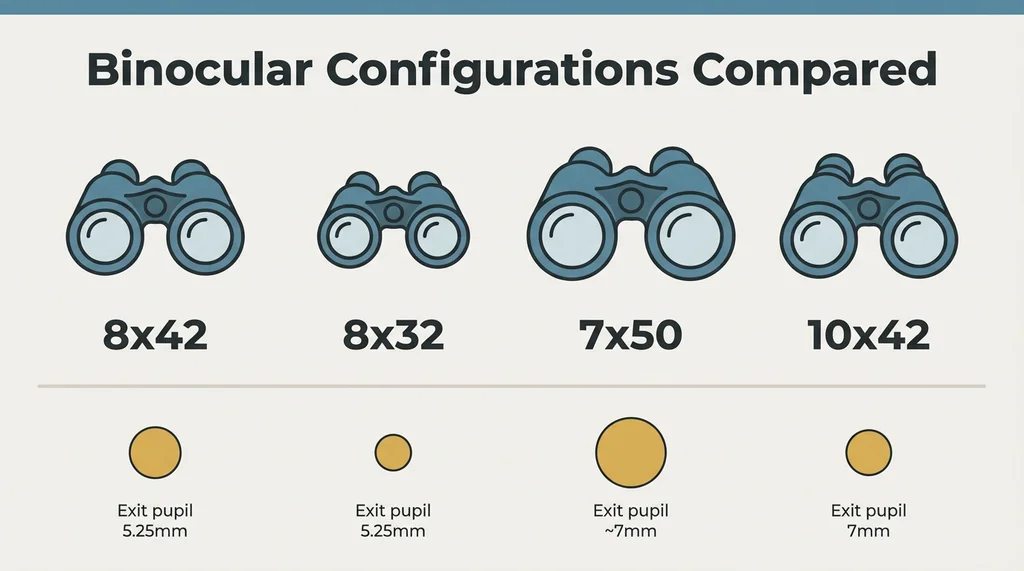
Divide the objective lens diameter by the magnification and you get the exit pupil — the diameter of the light beam that enters your eye. An 8x42 binocular has a 5.25mm exit pupil. A 7x50 binocular has a 7.14mm exit pupil.
Human pupils dilate to roughly 7mm in complete darkness and contract to about 2-3mm in bright daylight. This matters enormously for stargazing. A binocular with a 3.5mm exit pupil (like a 10x35) is wasting most of its potential in dark conditions because your dilated pupil can accept a larger beam than the binocular delivers. For serious stargazing, an exit pupil of 5mm or larger is the practical minimum. The 8x42's 5.25mm exit pupil just clears this threshold — which is why it works reasonably well after dark even though it wasn't designed as an astronomy instrument.
The 7x50 configuration, historically the standard for marine and astronomical use, produces a 7.14mm exit pupil that matches maximum pupil dilation. This makes 7x50 binoculars genuinely excellent for stargazing. The tradeoff is that at 7x magnification, birds appear smaller than at 8x, and the bulkier 50mm objectives make these binoculars heavy and difficult to hold steady for extended bird watching sessions.
Eye Relief: The Specification Glasses Wearers Cannot Ignore
Eye relief is the distance from the eyepiece lens to the point where the full field of view is visible. Glasses wearers cannot press their eyes directly against the eyepiece, which means they need binoculars with enough eye relief to see the complete image while wearing glasses.
The practical minimum for glasses wearers is 15mm of eye relief. Anything less results in a visible black ring around the image — the binocular is showing you less than its full field of view. At 18mm or more, most glasses wearers can see the complete image without compromise. David, who wears glasses, uses 8x42 binoculars with 18mm eye relief and adjustable twist-up eyecups that lock at multiple positions. The ability to set the eyecups and have them stay set — rather than slowly collapsing during use — is a detail worth checking in reviews before purchasing.
The first pair of binoculars in this household were 10x50 with 12mm eye relief. For a glasses wearer, they were essentially unusable. That's part of why they lasted only six months.
Prism Type: Roof vs. Porro
Binoculars use one of two prism configurations to fold the light path into a compact package. Porro prisms — the classic offset-barrel design — produce excellent optical quality at lower price points because the prism alignment is less critical during manufacturing. Roof prisms allow for a straight-barrel design that's more compact and water-resistant, but require tighter manufacturing tolerances to achieve the same image quality.
Tom at the hardware store, who has let customers test binoculars at home for years, uses porro prism binoculars himself. He's not wrong. A $150 porro prism binocular often outperforms a $150 roof prism binocular in pure optical terms. But at $250 and above, quality roof prism binoculars match or exceed porro prism performance while offering better weather sealing and a slimmer profile.
For bird watching in wet conditions — which describes most of New England from October through May — the weather resistance of a quality roof prism binocular is a practical advantage. For stargazing, where you're typically stationary and the weather is clear by necessity, either prism type performs equally well.
The Price Reality: Where Performance Thresholds Actually Fall
Genuinely useful binoculars start around $150 to $200. Below that threshold, optical quality typically compromises the experience enough that you'll be frustrated rather than delighted. The coatings on the lenses aren't fully multi-coated, which means lower light transmission and more glare. The prism alignment may be slightly off, causing eyestrain during extended use. The focus mechanism may be imprecise.
Between $200 and $400, you enter the range where most birders and casual astronomers find their permanent pair. Fully multi-coated optics, phase-corrected roof prisms (which improve image sharpness), and genuine weather sealing are all achievable in this range. The 8x42 binoculars used here daily cost $240 three years ago and have not required replacement or repair.
From $400 to $800, improvements become incremental rather than transformative — better edge sharpness, slightly improved low-light performance, more refined focusing mechanisms. These are real improvements, but they're meaningful primarily to experienced users who will notice and appreciate the difference.
Above $800, you're in professional and enthusiast territory. Dr. Fielding's 8x32 binoculars, purchased in 2004 for $180 (approximately $280 in today's money), have lasted twenty years of field research. The lesson isn't that expensive binoculars are unnecessary — it's that a well-chosen mid-range pair, maintained properly, can serve for decades.
Configurations Worth Considering for Dual Use
8x42 Roof Prism remains the most versatile configuration for someone who wants one pair that handles both bird watching and casual stargazing. The 5.25mm exit pupil provides adequate low-light performance, 8x magnification is stable enough for hand-holding, and 42mm objectives gather enough light for dawn and dusk bird activity. Close focus distance matters for bird watching — look for 6.5 feet or closer, which allows you to observe birds at the feeder without the image going blurry.
8x32 Roof Prism makes sense for birders who prioritize portability and do their stargazing casually. The 4mm exit pupil is adequate for moon watching and bright star clusters but limiting for deep-sky objects. At 18 ounces versus 24 ounces for an 8x42, the weight reduction is meaningful on long walks. This is the configuration that has served forty years of field research.
7x50 Porro Prism is the choice for someone who prioritizes stargazing but still wants to watch birds. The 7.14mm exit pupil is genuinely excellent after dark, and 7x magnification is stable and wide-field. The significant weight (often 35-40 ounces) and bulky profile make these less comfortable for extended bird watching, but they perform beautifully on clear nights.
10x42 Roof Prism suits birders who primarily watch from stationary positions — a window, a blind, or a fixed observation point. The higher magnification fills the frame with distant subjects but narrows the field of view and amplifies hand tremor. For stargazing, 10x is better used on a tripod. The $25 tabletop tripod kept by the kitchen window for extended cardinal observation demonstrates that tripod support doesn't require significant investment.
Practical Features That Actually Matter
Close focus distance is frequently overlooked in specifications but critical for bird watching. A binocular that can't focus closer than 15 or 20 feet is useless for birds at a feeder. Look for 8 feet or less; 6.5 feet or less is excellent.
Field of view describes how wide a swath you see at 1,000 yards. A 420-foot field of view at 1,000 yards is good for an 8x42. Wider fields make it easier to locate and track moving birds. For stargazing, wider field of view lets you take in more of the night sky simultaneously — the Pleiades cluster, for instance, fits beautifully in a wide-field 8x42 but gets cropped in narrower configurations.
Weight and balance determine whether binoculars get used or stay in a drawer. A binocular that's too heavy causes neck fatigue and arm fatigue, which means shorter observation sessions and, eventually, a pair that never leaves the shelf. The jump from 24 ounces to 47 ounces — the weight of those first 10x50 binoculars — is the difference between a tool you reach for automatically and one you have to decide to bring.
Waterproofing and fog-proofing matter more than they seem. Nitrogen or argon purging prevents internal fogging when you bring cold binoculars into a warm house, then take them back outside. O-ring sealing keeps moisture out during rain or when you set them down in wet grass. These features are standard on binoculars above $200 from reputable manufacturers.
Making the Choice
The best binoculars for bird watching and stargazing aren't the ones with the most impressive specifications on paper — they're the ones that get used. A pair that's comfortable, optically clear, and appropriately sized for how and where you observe will outperform a technically superior pair that stays home because it's too heavy or too precious to bring into the field.
For most people starting out or looking to replace a disappointing first pair, an 8x42 roof prism binocular in the $200 to $350 range covers both bird watching and casual stargazing with genuine competence. Glasses wearers should confirm at least 18mm of eye relief and adjustable, locking eyecups before purchasing. Anyone prioritizing stargazing should consider 7x50 porro prism binoculars as an alternative — optically excellent after dark, reasonably capable for daytime bird watching, and often less expensive than equivalent roof prism configurations.
The $420 spent learning these lessons was, in retrospect, a fairly efficient education. The right pair, chosen with these specifications in mind, should last considerably longer than six months.