Binoculars for Bird Watching: How to Choose the Right Pair
Best Binoculars for Wildlife and Bird Watching: A Practical Guide to Choosing the Right Pair
Choosing binoculars for bird watching is one of those decisions that feels simple until you're standing in a store holding six different pairs, all of which look roughly identical, and a salesperson is explaining exit pupils with the enthusiasm of someone who genuinely believes you care about exit pupils right now. You don't. You want to see birds. Clearly. Without your arms going numb.
The good news is that the decision is actually simpler than the optics industry wants you to believe. A few key specifications matter enormously. Most of the rest is marketing. After spending $420 across two binocular purchases over three years — the first a $180 mistake that lasted six months, the second a $240 pair that's been in daily use ever since — the path from confused beginner to confident buyer comes into focus pretty quickly.
Here's what actually matters, what doesn't, and which specifications to look for based on how you plan to use them.
Key Takeaways
- Choose 8x magnification over 10x — the wider field of view and reduced hand-shake make tracking moving birds significantly easier
- Glasses wearers need at least 18mm of eye relief to see the full image without dark edges around the view
- A close focus distance of 8 feet or less is required to watch birds at a feeder within 12 feet of a window
- Fully multi-coated lenses are non-negotiable — lower coating standards lose detail and contrast in low-light dawn and dusk conditions
- A $240 to $300 budget covers 8x42 binoculars with fully multi-coated lenses, waterproofing, and 18mm eye relief without compromising key specs
Why Magnification Isn't the Most Important Number
Most first-time buyers fixate on magnification. Higher must be better, right? More zoom means more bird. This is the logic that leads people to buy 10x50 binoculars and spend six months wondering why bird watching feels like hard work.
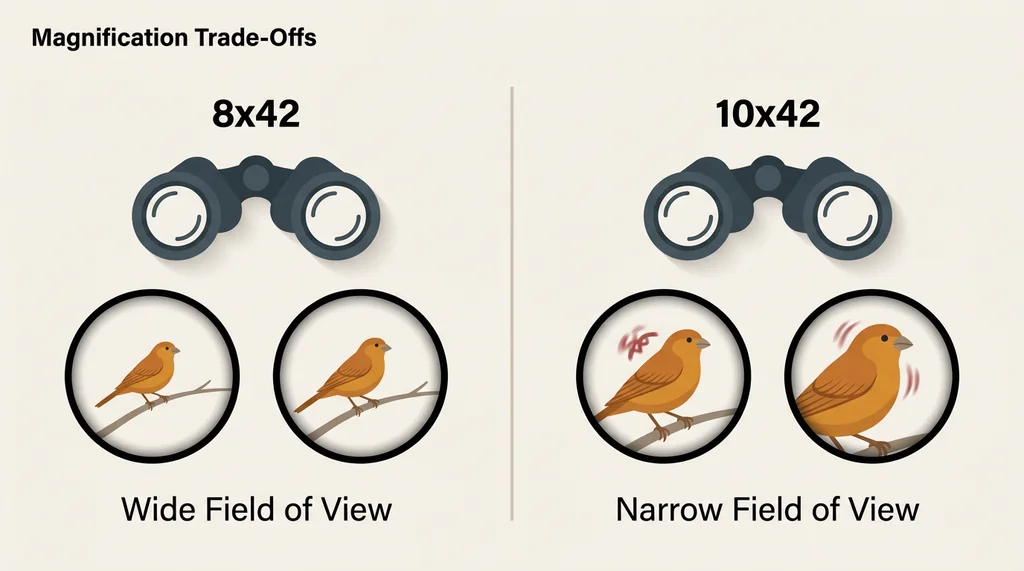
High magnification comes with real trade-offs. A 10x binocular magnifies everything — including the tiny tremors in your hands. At 10x, any movement becomes visible shake, which makes tracking a moving bird genuinely difficult. The field of view (how wide a swath of landscape you can see at once) also narrows as magnification increases, which is exactly the wrong direction when you're trying to find a warbler that just disappeared into a hedgerow.
The birding community has largely converged on 8x magnification as the sweet spot for good reason. Eight-power gives you enough detail to identify plumage markings at reasonable distances, a wide enough field of view to actually find and track birds in motion, and enough stability to use handheld without fatigue. Dr. Patricia Fielding, who has studied bird physiology for forty years and has used the same 8x32 binoculars for field research for two decades, has never felt the need to upgrade to higher magnification. When someone with forty years of professional observation experience sticks with 8x, that's worth taking seriously.
The second number in binocular specifications — the objective lens diameter — does matter, but perhaps not in the way you'd expect. A 42mm objective lens (as in 8x42) gathers meaningfully more light than a 32mm lens, which translates to better performance in low-light conditions: dawn, dusk, and overcast days when birds are often most active. The trade-off is weight. An 8x42 pair typically weighs around 24 ounces, while an 8x32 comes in around 18 ounces.
For most wildlife watching situations — particularly feeder watching and woodland birding — 8x42 is the recommended configuration. The extra light-gathering ability of the 42mm lens earns its weight penalty. If you're primarily doing long-distance hiking where every ounce matters, 8x32 is a legitimate choice and the configuration that professional field researchers often prefer for exactly that reason.
The Specification That Determines Whether You Can Actually Use Them
Eye relief is the distance between the eyepiece lens and the point where the full image is visible. For people who wear glasses, this number is critical and often ignored until they've already made an expensive mistake.
Standard binoculars have eye relief in the 12-14mm range. If you wear glasses, you cannot press the binoculars against your eye sockets the way non-glasses wearers do, which means you're viewing from slightly further back — and with standard eye relief, you lose the edges of the image. The view through the eyepiece shrinks to a smaller, frustrating circle with dark edges.
Long eye relief binoculars, typically 16mm or more, solve this problem. For glasses wearers, 18mm or more of eye relief is the practical threshold. Most quality binoculars in this range also feature adjustable eyecups — twist-up or fold-down rubber cups that let you set the exact distance between your eye and the lens. This matters whether or not you wear glasses, because eye anatomy varies from person to person.
The 10x50 binoculars that proved to be an expensive early lesson had 12mm of eye relief. At 47 ounces and with a minimum focus distance of 20 feet, they were essentially unusable for the yard birds they were purchased to watch. A cardinal sitting on a feeder 15 feet away was simply too close to focus on. That's a specification problem, not a user error — but it's the kind of problem you only learn about after the return window closes.
Current 8x42 binoculars have 18mm eye relief and adjustable eyecups, which is why David — who wears glasses — can use the same pair without compromise. When two people in a household with different visual needs can share a single pair of binoculars without either person getting a degraded experience, that's a specification doing its job.
Close Focus Distance: The Overlooked Specification for Feeder Watchers
If you plan to watch birds at a feeder, in a garden, or anywhere within 20 feet, close focus distance matters more than almost any other specification. Many binoculars — particularly older designs and budget models — cannot focus on anything closer than 15 to 20 feet. This seems fine until you realize that a bird on a feeder 12 feet from your window turns into a blur.
A close focus distance of 6.5 feet means you can watch a hummingbird hovering at a feeder just outside a window, a butterfly on a flower in the garden, or a wren investigating a nest box three feet away — all in sharp, detailed focus. This specification rarely gets featured prominently in marketing materials, but it's the difference between binoculars that work for your actual situation and binoculars that work for the situation in the product photos.
When shopping, look for close focus distances of 8 feet or less for feeder and garden watching. Some high-quality models achieve 5 or 6 feet, which opens up a remarkable range of close-range observation.
Prism Type: Roof vs. Porro
Binoculars use internal prisms to orient the image correctly. The two main designs — roof prism and porro prism — create noticeably different physical shapes and have different optical and practical characteristics.
Roof prism binoculars have the straight, cylindrical barrel shape that most people picture when they think of modern binoculars. The objective lenses align directly with the eyepieces. They're compact, durable, and weather-resistant designs are widely available. The optical path is more complex, which historically made them more expensive to manufacture at high quality — though this gap has narrowed considerably in recent years.
Porro prism binoculars have the offset, Z-shaped barrel that looks more old-fashioned. The objective lenses are wider apart than the eyepieces, which actually provides better depth perception and a slightly more three-dimensional image. They tend to offer excellent optical quality at lower price points because the prism design is simpler to manufacture well. Tom at the local hardware store, who's been watching birds longer than most people have been paying attention to them, uses porro prism binoculars and has no interest in switching. The image quality at his price point is genuinely hard to match with a roof prism design.
For most buyers, roof prism binoculars are the practical choice — they're more durable, easier to waterproof, and fit more naturally in a jacket pocket or around a neck. But if budget is a primary constraint and optical quality matters more than form factor, a porro prism binocular in the $100-150 range will often outperform a roof prism at the same price.
Lens Coatings: What the Labels Actually Mean
Binocular marketing is full of coating terminology that sounds technical and meaningful. Here's a quick decoder:
Coated: At least one lens surface has an anti-reflection coating. This is the minimum standard and not particularly impressive.
Fully coated: All air-to-glass surfaces have at least one coating layer. This is the minimum you should accept.
Multi-coated: At least one lens surface has multiple coating layers. Better than fully coated, but still not the top tier.
Fully multi-coated: All air-to-glass surfaces have multiple coating layers. This is what you want. Fully multi-coated lenses transmit more light, produce better contrast, and show truer colors than any of the lower coating standards.
The difference between fully coated and fully multi-coated isn't subtle in poor light conditions. At dawn in October, watching a dark-plumaged bird in the shadow of a spruce tree, fully multi-coated lenses will show you detail that lesser coatings simply lose. For birding specifically, where color and contrast are often the primary identification tools, this is not a specification to compromise on.
Most binoculars in the $200 and above range are fully multi-coated. Below $150, you'll find a mix, and the coating specification should be one of the first things you verify.
What to Spend: The Honest Price Guide
Genuinely useful binoculars start around $150 to $200. Below that threshold, you're typically compromising on optical quality in ways that matter — coatings, prism glass quality, or mechanical precision that affects focus smoothness and image sharpness edge to edge.
The $200-400 range is where most dedicated bird watchers find their long-term pair. At $240, the current 8x42 pair described above has been in daily use for three years without a single optical or mechanical complaint. The glass is clear, the focus wheel is smooth, and the waterproofing has survived a genuine amount of New England weather. Three years of daily use at $240 works out to about 22 cents per day, which is a reasonable way to think about what "expensive" actually means over time.
The $400-800 range brings meaningful improvements in edge-to-edge sharpness, low-light performance, and build quality. If you're doing serious field work, traveling to dedicated birding locations, or simply want the best image quality available at a non-professional price point, this range is worth the investment.
Above $800, you're in professional and enthusiast territory. The optical improvements are real but incremental. Dr. Fielding's $180 binoculars from 2004 — worth about $280 in today's money — have served forty years of field research. Spending more doesn't automatically produce better birding.
For someone just starting out: spend at least $150, target the $200-300 range if possible, and prioritize 8x42 configuration, fully multi-coated lenses, and at least 16mm of eye relief (18mm if anyone in the household wears glasses).
Waterproofing and Durability
Bird watching happens outside, in weather that doesn't consult your schedule. Waterproofing matters.
Look for binoculars described as "waterproof" rather than "water-resistant." Waterproof binoculars are typically nitrogen-purged or argon-purged, meaning the internal air has been replaced with an inert gas. This prevents internal fogging when moving between temperature extremes — like stepping out of a warm car into cold morning air — and means moisture cannot enter the barrel even when fully submerged briefly.
Water-resistant binoculars can handle light rain but will fog internally when exposed to temperature changes or sustained moisture. For occasional use in good weather, this may be acceptable. For regular outdoor use in variable conditions, waterproof is worth the modest price premium it typically commands.
The Tripod Question
Most binoculars are designed for handheld use, and 8x42 binoculars at 24 ounces are genuinely comfortable to hold for extended periods. But for stationary observation — watching a nest, monitoring a feeder, or waiting for a specific bird to return — a tripod adapter removes all fatigue from the equation.
Most quality binoculars have a threaded socket on the front barrel for a tripod adapter. A $25 tabletop tripod by a kitchen window, paired with a simple binocular-to-tripod adapter (typically $10-15), creates a stable observation platform that makes extended cardinal watching genuinely comfortable. The tripod doesn't replace handheld use; it supplements it for the situations where you're going to be looking in one direction for twenty minutes.
Making the Final Choice
The specifications that matter most, in order of practical importance for most bird watchers:
- Magnification: 8x for almost everyone
- Objective lens diameter: 42mm for general use, 32mm if weight is a priority
- Eye relief: 18mm minimum for glasses wearers, 16mm minimum for everyone else
- Close focus distance: 8 feet or less for feeder and garden watching
- Lens coatings: Fully multi-coated, no exceptions
- Waterproofing: Waterproof (nitrogen or argon-purged) for regular outdoor use
- Prism type: Roof prism for durability and portability; porro prism for value
The best binoculars for wildlife and bird watching are the ones that match your actual use case, fit your budget without requiring you to compromise on the specifications that matter, and feel comfortable enough in your hands that you reach for them automatically. Optical perfection sitting in a drawer beats nothing. A good pair you actually use beats an excellent pair that stays home because it's too heavy or too precious.
Three years of daily use and thousands of mornings at the kitchen window have made one thing clear: the right binoculars disappear from your awareness entirely. You stop thinking about the tool and start thinking about the bird. That's the goal, and it's achievable without spending a fortune to get there.