Binoculars with Built-In Camera for Bird Watching
Best Binoculars with a Built-In Camera for Bird Watching: What Actually Works in the Field
There's a particular frustration that comes with watching a bird through binoculars, knowing you're seeing something remarkable, and having absolutely no way to prove it happened. The bird lands, does something extraordinary, and flies off before you can reach for your phone. That gap between observation and documentation is exactly what binoculars with built-in cameras promise to close — and why so many birders are genuinely curious about whether they're worth the investment.
The honest answer is complicated. These hybrid devices sit at an interesting intersection of optics and photography, and the compromises involved aren't always obvious from a product listing. Understanding what you're actually buying — and what you're giving up — makes the difference between a useful tool and an expensive disappointment that sits in a closet.
Key Takeaways
- Camera binoculars in the $250–$500 range with fully multi-coated lenses and 8x42 configuration offer the best balance of optics and documentation capability.
- Glasses wearers must verify a minimum of 18mm eye relief before purchasing any camera binocular to see the full field of view.
- A dedicated binocular paired with a digiscoping adapter produces better image quality than a camera binocular at the same total cost, but requires 30–60 seconds of setup time.
- Smart feeder cameras recognizing 6,000+ species outperform camera binoculars for backyard documentation because the subject is stationary and the camera can be optimally positioned.
- Camera resolution matters less than lens coating quality — a 10-megapixel sensor behind fully multi-coated optics outperforms a 16-megapixel sensor behind mediocre glass.
How Binoculars with Built-In Cameras Actually Work
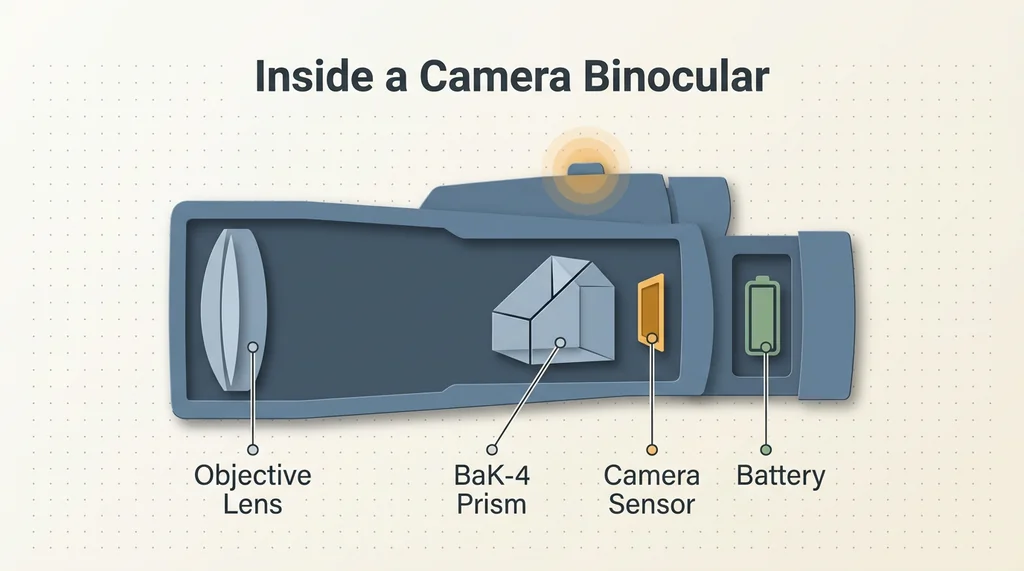
Before evaluating specific products, the mechanics matter. Built-in camera binoculars integrate a digital sensor, typically positioned behind one of the objective lenses, that captures what the optical system sees. A shutter button on the housing triggers the shot, and images are stored on a micro SD card or transferred via Bluetooth or USB to a phone or computer.
The fundamental engineering challenge is that good binoculars and good cameras want different things from their optical systems. A quality binocular objective lens is optimized for transmitting maximum light to your eye across a wide field of view. A camera sensor needs precise, calibrated light delivery to a fixed focal plane. Designing one lens assembly to do both simultaneously without compromising either is genuinely difficult, and most consumer-grade camera binoculars resolve this tension by accepting optical compromises on both sides.
The result is that camera binoculars typically underperform dedicated binoculars of similar price on pure optical quality, and they produce images that fall short of what a dedicated camera with a telephoto lens would capture. That's not a flaw unique to any particular brand — it's a structural reality of the hybrid design.
What they offer in exchange is convenience and spontaneity. When a painted bunting lands three feet from an unfamiliar feeder, you don't have time to switch devices. One button, and the moment is captured.
What the Specs Actually Mean for Bird Watching
Camera binoculars marketed for birding typically cluster around a few standard configurations, and knowing how to read them prevents disappointment.
Magnification and objective lens diameter follow the same conventions as standard binoculars. An 8x42 camera binocular offers 8x magnification through a 42mm objective lens — the same configuration that experienced birders consistently recommend for general use. The 8x magnification provides a wide enough field of view to track moving birds, while 42mm lets in enough light for dawn and dusk observation. Some models offer 10x, which provides more reach but narrows the field of view and amplifies hand tremor, making it harder to hold a sharp image.
Camera resolution in current models ranges from 2 megapixels on budget options to 16 megapixels on premium units. Resolution matters less than many buyers expect because the limiting factor is usually the optical system delivering light to the sensor, not the sensor itself. A 12-megapixel camera behind an optically mediocre lens produces a detailed image of a blur. The more meaningful specification is the quality of the coatings on the optical elements — fully multi-coated lenses transmit significantly more light than partially coated ones, which directly affects image brightness and color accuracy.
Video capability in better models now reaches 2K resolution, though 1080p is more common at mid-range price points. For bird watching specifically, video often proves more valuable than still photography because it captures behavior — a warbler's feeding technique, a hawk's hunting approach — that a single frame can't convey.
Eye relief remains critical for anyone who wears glasses. Glasses wearers need a minimum of 18mm of eye relief to see the full field of view without removing their eyewear. Many camera binoculars, particularly older or budget designs, offer only 12 to 14mm of eye relief, which forces glasses wearers to choose between wearing their glasses and seeing the full image. This is a non-negotiable specification for a significant portion of birders.
Close focus distance determines how near a subject can be before the binoculars lose focus. For bird watching at feeders or in gardens, a close focus of 6 to 8 feet is genuinely useful. Models that can't focus closer than 15 or 20 feet miss a substantial percentage of backyard birding opportunities.
The Price Tiers and What You Get at Each
Under $100: This category exists, but the products in it are better understood as novelty items than birding tools. Optical quality at this price point typically produces images with chromatic aberration (color fringing), low contrast, and narrow fields of view. The cameras tend to be 2 to 5 megapixels with no image stabilization. For casual documentation of obvious species at close range, they function. For serious birding or identification of similar-looking species, they don't.
$100 to $250: The more credible entry-level options live here. Optical quality improves meaningfully, with some models offering BaK-4 prism glass and multi-coated lenses. Camera resolution reaches 8 to 12 megapixels in better units. Models in this range from brands like Apeman and Gosky have attracted legitimate positive reviews from birders who use them primarily for documentation rather than identification. The trade-off is that the optical performance still falls noticeably short of a dedicated binocular at the same price — a $200 standard binocular will outperform a $200 camera binocular on pure optics.
$250 to $500: This is where the category becomes genuinely interesting. Several manufacturers offer camera binoculars with 8x42 or 10x42 configurations, fully multi-coated optics, HD video, and Bluetooth connectivity for direct transfer to smartphones. Brands including Bresser and Kowa have products in this range that ornithology hobbyists use seriously. Image stabilization begins appearing at the upper end of this tier, which makes a meaningful difference for video capture.
Above $500: The premium end includes models with optical stabilization, high-resolution sensors, and optical quality approaching dedicated birding binoculars. Swarovski's ATX series and Canon's image-stabilized binoculars (which can be paired with phone mounts for documentation) represent the professional-grade approach, though they're typically recommended for users who have already established that they need this specific combination rather than separate dedicated tools.
The Honest Trade-Off Analysis
The birding community has a somewhat divided view on camera binoculars, and the division breaks down along predictable lines.
Birders who prioritize documentation — lifers, rare bird chasers, citizen science contributors — tend to find camera binoculars genuinely useful despite their optical compromises. The ability to capture an image in the same moment as observation, without switching devices, has real practical value when seconds matter. For submitting records to eBird or other databases, even an imperfect image is often more valuable than a written description alone.
Birders who prioritize optical experience — those who bird for the quality of the observation itself, the detail visible in plumage, the satisfaction of a sharp image — tend to find camera binoculars frustrating. The optical compromises are noticeable when compared to a quality dedicated binocular, and the camera functionality adds weight and bulk that affects handling.
The weight consideration is more significant than it sounds. A standard 8x42 binocular typically weighs 22 to 26 ounces. Camera binoculars at comparable specifications often run 28 to 35 ounces because of the added electronics, battery, and sensor housing. Over several hours of field birding, that difference registers in neck and shoulder fatigue. For stationary feeder watching or short walks, it's less relevant.
Battery life introduces a variable that standard binoculars don't have. Most camera binoculars run two to four hours of active use on a charge, with some models offering replaceable AA batteries as a backup option. Running out of battery mid-session and losing camera functionality while retaining optical function is a minor inconvenience. Running out of battery and losing optical function — which doesn't happen in models with properly passive optical systems, but is worth confirming before purchase — would be a serious problem.
Pairing Strategy: When Separate Tools Beat a Hybrid
For birders who are genuinely uncertain whether a camera binocular meets their needs, there's a legitimate alternative worth considering. A dedicated binocular in the $200 to $300 range paired with a smartphone digiscoping adapter — a bracket that holds a phone camera against the binocular eyepiece — can produce results that exceed camera binoculars at similar total cost. The optical quality of the binocular is uncompromised, and modern smartphone cameras with computational photography produce surprisingly capable images through a quality eyepiece.
The limitation is setup time. Attaching a phone to a digiscoping adapter takes thirty to sixty seconds, which eliminates the spontaneous capture advantage that camera binoculars offer. For planned observation sessions at a known location — a feeder setup, a known perch, a reliable territory — the digiscoping approach often produces better results. For opportunistic field birding where subjects are unpredictable, the integrated camera has a real advantage.
Smart bird feeder cameras represent a third option worth mentioning for backyard birders specifically. Systems like Bird Buddy's Smart Feeder Pro, which PCMag has rated as a top-tier option in the category, bring the camera to the bird rather than asking the birder to aim at a moving target. These systems use AI identification — typically MobileNet neural network architecture running on-device — to recognize and log species automatically. Consumer-grade models currently recognize around 6,000 or more species, while more advanced commercial systems push past 11,000. For feeder documentation specifically, a smart feeder camera often outperforms a camera binocular because the subject is stationary and the camera can be optimally positioned.
Practical Recommendations by Use Case
For field birding with occasional documentation needs: A mid-range camera binocular in the $200 to $350 range with 8x42 configuration, fully multi-coated lenses, and minimum 18mm eye relief (critical for glasses wearers) offers a workable compromise. Prioritize optical quality over camera megapixels — a 10-megapixel camera behind excellent optics beats a 16-megapixel camera behind mediocre ones.
For backyard feeder watching with serious documentation goals: A quality dedicated binocular paired with either a digiscoping adapter or a smart feeder camera system will outperform a camera binocular at equivalent cost. The feeder provides a fixed, predictable subject that rewards a stationary camera setup.
For traveling birders who want minimal gear: Camera binoculars make their strongest case here. Carrying one device instead of two genuinely matters when packing for a trip. In this context, the optical compromises are more acceptable than the logistical simplicity is valuable.
For birders new to the hobby: Starting with a dedicated binocular in the $150 to $250 range and adding documentation capability later — through a phone adapter or smart feeder — typically produces better results than beginning with a camera binocular. Learning to use binoculars well is its own skill, and learning it on an optically compromised instrument adds unnecessary difficulty to an already steep learning curve.
The camera binocular category has improved meaningfully over the past several years, and the best current models represent genuine tools rather than gimmicks. They're not the right choice for every birder, but for the right use case — field documentation, travel birding, spontaneous capture — they solve a real problem in a way that separate devices simply can't replicate. Knowing which category you fall into before buying is what separates a useful purchase from another item in the learning tax column.