Compact Binoculars for Bird Watching: How to Choose
Best Compact Binoculars for Bird Watching: A Practical Guide to Choosing the Right Pair
There's a specific kind of frustration that comes from watching a bird you can't identify. It lands twelve feet away, does something remarkable with its tail, and by the time you've fumbled with binoculars that weigh as much as a small brick, it's gone. The feeder is empty. The branch is bare. You're left with a vague impression of "brownish, medium-sized, interesting."
Good binoculars don't just improve bird watching. They transform it from an exercise in squinting into something genuinely immersive — the difference between watching birds and actually seeing them. The compact category, specifically, has become increasingly sophisticated over the past decade. Optics that once required a full-size instrument to achieve can now fit in a jacket pocket, which matters enormously when you're standing in a field at dawn or craning your neck at a warbler forty feet up.
This guide focuses on compact binoculars for bird watching: what the specifications actually mean, where the trade-offs live, and which options consistently perform across the range of conditions that birders encounter. The research draws on optical physics, field testing principles, and the accumulated wisdom of what separates genuinely useful glass from the expensive disappointments that fill the back shelves of closets everywhere.
Key Takeaways
- Compact binoculars (30mm or smaller objective) weigh 9–15 oz versus 24–28 oz for full-size 8x42s, making them the practical choice for hikes over two hours.
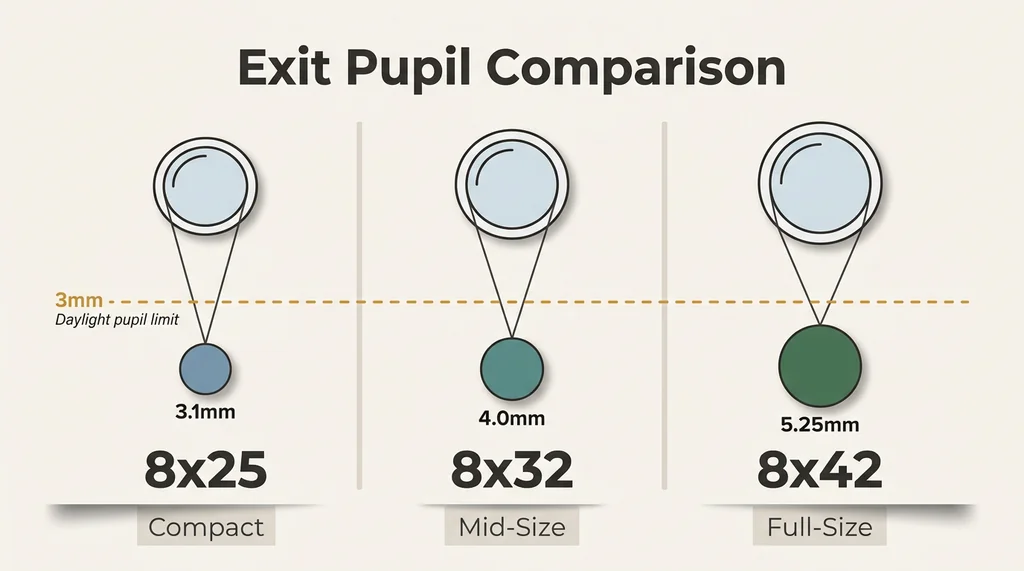
- An 8x25 produces a 3.1mm exit pupil versus 5.25mm for an 8x42, meaning compact binoculars deliver noticeably dimmer images at dawn and dusk.
- Eyeglass wearers need at least 14mm of eye relief — ideally 16mm or more — to see the full field of view without a dark vignette ring.
- Fully multi-coated lenses transmit 90–95% of light; skipping this coating on budget models produces visibly lower contrast and color saturation.
- The Celestron Nature DX 8x32 at $80–$100 delivers BaK-4 prisms and fully multi-coated optics, outperforming its price point for beginner birders.
What "Compact" Actually Means in Binocular Terms
The word compact gets applied liberally to binoculars, which creates real confusion. Technically, compact binoculars use objective lenses (the big lenses at the front) measuring 30mm or smaller. Full-size binoculars typically run 42mm or larger. Mid-size sits in between, usually around 32mm.
This matters because the objective lens diameter determines how much light enters the instrument. More light means better performance in low-light conditions — dawn, dusk, dense forest canopy. A 25mm compact and a 42mm full-size at the same magnification will perform identically in bright midday sun. At 6 AM on a cloudy morning, watching a thrush work through leaf litter, the 42mm wins decisively.
So why choose compact? Weight, size, and portability. A quality 8x25 compact weighs around 9 to 11 ounces. A quality 8x42 full-size runs 24 to 28 ounces. That difference is irrelevant for window watching and significant for a six-hour hike. Compact binoculars also fit in a coat pocket, which changes how often you actually carry them — and the binoculars you have with you are always better than the binoculars you left in the car.
The Magnification Question
Compact binoculars commonly come in 8x25, 10x25, and 8x21 configurations. The first number is magnification; the second is objective lens diameter in millimeters.
Eight power is the standard recommendation for bird watching, and the reasons are practical. Higher magnification amplifies hand shake, which becomes visible above 10x without a tripod. It also narrows the field of view, which makes finding fast-moving birds harder. Eight power hits the sweet spot: enough magnification to see field marks clearly, enough stability to hold steady, enough field of view to track movement.
Ten power compact binoculars exist, and they have their uses — hawk watching from a fixed position, scanning distant shorebirds across a flat marsh. For general birding, including backyard watching and woodland trails, 8x is the more versatile choice.
Exit Pupil and Low-Light Performance
Exit pupil is calculated by dividing the objective lens diameter by magnification. An 8x25 produces an exit pupil of 3.1mm. An 8x42 produces 5.25mm. The human pupil in daylight is roughly 2 to 3mm; in low light, it can dilate to 5 to 7mm depending on age.
This is where compact binoculars show their fundamental limitation. That 3.1mm exit pupil is fine in good light. At dawn, when a hermit thrush is singing from a dark thicket, you're working with a smaller light bundle than a full-size instrument would provide. The image will be dimmer. This isn't a flaw in any specific compact binocular — it's physics.
For dedicated low-light birding, full-size wins. For everything else, modern compact binoculars with quality glass and coatings perform remarkably well.
The Specifications That Actually Matter
Close Focus Distance
Bird watching involves subjects at wildly varying distances. A warbler might be eight feet away in a shrub. A hawk might be circling at 200 yards. Close focus distance — how near an object can be before the binoculars can no longer focus on it — determines how useful your instrument is for the close encounters.
Many compact binoculars struggle here. Close focus of 15 to 20 feet is common and genuinely limiting. Watching a butterfly land on a nearby flower, or tracking a wren working through undergrowth ten feet away, becomes impossible. Quality compact binoculars achieve close focus of 6 to 8 feet, which opens up the full range of birding encounters.
Field of View
Field of view is measured either in feet at 1,000 yards or in degrees. A wider field of view makes it easier to locate birds and track movement. For compact binoculars, 300 to 330 feet at 1,000 yards is typical; 350 feet or more is excellent.
Wider field of view tends to come with optical trade-offs — edge sharpness often degrades as the field widens. The best compact binoculars maintain reasonable sharpness across most of the field, with only slight softening at the extreme edges.
Eye Relief
Eye relief is the distance between the eyepiece lens and where your eye needs to be to see the full field of view. For eyeglass wearers, this is critical. Glasses hold your eye further from the eyepiece, so you need longer eye relief — typically 14mm or more, ideally 16mm or above — to see the complete image without vignetting (the dark ring around the edge of the view).
Most compact binoculars offer 11 to 14mm of eye relief. That's adequate for non-eyeglass wearers. For glasses wearers, the search for compact binoculars with sufficient eye relief is genuinely difficult. Some manufacturers offer twist-up eyecups with multiple positions; the best of these can achieve 15 to 16mm of usable eye relief even in compact form.
Prism Type: Roof vs. Porro
Compact binoculars almost universally use roof prisms, which fold the optical path to create the straight-barrel design. Porro prism binoculars — the classic bent shape, wider at the front than the eyepieces — are rare in compact form.
Roof prisms require phase correction coatings to maintain image quality; without them, the image loses contrast and resolution. Quality roof prism compacts use phase-corrected prisms. Budget options often skip this coating, and the difference is visible in side-by-side comparison.
Porro prism binoculars, when well-made, can produce exceptional images at lower price points because the optical path is simpler. Tom at the hardware store has used porro prisms for years and the image quality for the price is genuinely impressive — though the shape makes them less pocketable than roof prism designs.
Optical Quality: What Coatings Actually Do
Every glass surface reflects some light. A binocular with multiple lens and prism elements can lose 30 to 40 percent of incoming light to reflections without coatings. Anti-reflection coatings dramatically reduce this loss.
The coating terminology matters:
Coated: Single layer on some surfaces. Entry-level.
Fully coated: Single layer on all surfaces. Better.
Multi-coated: Multiple layers on some surfaces. Good.
Fully multi-coated: Multiple layers on all surfaces. This is what quality bird watching binoculars should have.
Fully multi-coated lenses transmit 90 to 95 percent of light, producing brighter, higher-contrast images. In direct comparison with a coated-only binocular, the difference is visible immediately — more saturated colors, cleaner shadows, better performance as light drops.
ED glass (extra-low dispersion) is another quality marker. Standard glass bends different wavelengths of light at slightly different angles, producing color fringing around high-contrast edges — a branch against bright sky, a bird's white throat patch in shade. ED glass minimizes this chromatic aberration. It's expensive to produce and meaningfully improves image quality, particularly at high magnification.
Recommended Compact Binoculars by Category
Best Overall Compact: Nikon Monarch M5 8x30
The Monarch M5 8x30 represents the current standard for what a quality compact bird watching binocular should do. At roughly $280 to $300 depending on retailer, it delivers fully multi-coated ED glass, phase-corrected roof prisms, and a close focus distance of 8.2 feet. Field of view is 367 feet at 1,000 yards — genuinely wide for a compact. Weight is 15.9 ounces.
The image is bright and sharp through most of the field, with only slight softening at the extreme edges. Color rendition is accurate; the ED glass keeps chromatic aberration controlled on high-contrast edges. The focus wheel is smooth and well-positioned. Eye relief is 15.4mm with twist-up eyecups, which is reasonable for eyeglass wearers, though at the lower end of comfortable.
For a birder who wants one compact binocular that performs well across most conditions — backyard, woodland trails, open fields — this is the recommendation.
Best Budget Compact: Celestron Nature DX 8x32
The Nature DX 8x32 occupies an interesting position: it's technically mid-size rather than compact (32mm objective), but at 19.9 ounces and a compact body design, it bridges the categories usefully. Price runs $80 to $100.
Fully multi-coated optics and BaK-4 prisms (the better prism glass type) at this price point is unusual. Close focus is 6.5 feet. Field of view is 388 feet at 1,000 yards. The image quality is noticeably better than budget binoculars with inferior coatings.
The limitations are real: eye relief is 17.5mm (good), but the eyecups are single-position twist-up and don't lock reliably. The focus wheel is slightly stiff when new. The waterproofing is splash-resistant rather than fully submersible. For birders starting out or working with limited budgets, this is where the money goes.
Best Compact for Eyeglass Wearers: Zeiss Terra ED 8x32
At $450 to $500, the Terra ED 8x32 is an investment. What justifies the cost for eyeglass wearers specifically is the 18mm eye relief combined with high-quality ED glass optics in a 22-ounce package. The image is exceptional — bright, sharp, with excellent color fidelity and minimal chromatic aberration.
The focus wheel is smooth and precise. Close focus is 5.2 feet, which is outstanding. The body is rubber-armored and fully waterproof. Zeiss's manufacturing quality control is among the best in the industry; sample variation between units is minimal.
For birders who wear glasses and want compact form factor without compromising optical quality or eye relief, the Terra ED is the answer. It's expensive. It also performs at a level that eliminates the desire to upgrade.
Best Ultralight Compact: Vortex Diamondback HD 8x28
The Diamondback HD 8x28 weighs 11.3 ounces and costs $170 to $190. For hiking birders who count every ounce, this is the calculation that makes sense.
Fully multi-coated HD glass produces images that exceed expectations for the price and weight. Close focus is 5 feet — better than many more expensive compacts. Field of view is 393 feet at 1,000 yards. Eye relief is 15mm.
The trade-off is low-light performance. At 3.5mm exit pupil, dawn and dusk birding is noticeably dimmer than with larger objectives. In good light, the image is excellent. Vortex's lifetime warranty (no-fault replacement) removes the risk from the purchase.
Best Compact Under $150: Bushnell Powerview 2 8x25
The Powerview 2 8x25 costs $40 to $50 and represents the floor of what's worth buying. Multi-coated optics (not fully multi-coated) and BaK-4 prisms produce images that are functional in good light. Close focus is 8.5 feet. Weight is 8.5 ounces.
This is the recommendation for: children learning to bird watch, travel binoculars where theft or loss is a real concern, and gifting to someone who might become interested in birding. The image won't impress anyone who's used quality glass. It will work in daylight, it's light enough to carry everywhere, and if it breaks or disappears, the financial loss is manageable.
Spending less than $40 on binoculars for bird watching produces instruments that are frustrating rather than functional. The Powerview 2 is genuinely the minimum viable product.
Practical Considerations for Compact Binocular Use
Focus Wheel Ergonomics
The focus wheel position and action matter more than most spec sheets indicate. A well-positioned wheel can be operated with one finger while keeping the binoculars stable. A stiff wheel requires both hands and movement that disturbs aim. A loose wheel drifts and loses focus between uses.
The ideal focus wheel for bird watching moves roughly 540 degrees from close focus to infinity, allowing precise adjustment without requiring multiple full rotations. Wheels that cover the range in 360 degrees are faster to use but harder to fine-tune.
Test the focus wheel before buying when possible. Many camera and optics shops will let you focus on objects at different distances to evaluate the action.
Diopter Adjustment
The diopter corrects for differences in vision between your two eyes. It's typically located on the right eyepiece or as a separate ring near the right eyepiece. Once set correctly, you focus only with the center wheel.
Many birders set the diopter once and never touch it again. The diopter should lock in position — binoculars with diopters that slip out of adjustment are genuinely frustrating in the field.
Waterproofing and Fogging
Nitrogen-purged, O-ring sealed binoculars are waterproof and fog-proof internally. The nitrogen prevents internal fogging when moving from cold to warm environments — walking indoors after cold morning birding, for example. External fogging (condensation on the outer lenses) happens to all binoculars and clears quickly.
For serious birding in variable weather, waterproofing is worth paying for. For primarily backyard and fair-weather use, it's a nice feature rather than essential.
Harness vs. Neck Strap
Standard neck straps concentrate binocular weight on the back of the neck. For compact binoculars at 10 to 15 ounces, this is rarely a problem for short use. For full-day birding or heavier instruments, a binocular harness distributes weight across the shoulders and chest, eliminating neck strain entirely.
Harnesses designed for compact binoculars hold them against the chest for quick access — faster than a neck strap and more secure than a jacket pocket. For birders who use their binoculars frequently throughout the day, the ergonomic improvement is substantial.
When Compact Isn't the Right Answer
Compact binoculars make genuine trade-offs. Before committing to the compact category, it's worth being honest about your primary birding context.
Primarily backyard birding from a fixed position: Full-size 8x42 binoculars perform better in all light conditions and the weight is irrelevant when you're sitting at a window. A $25 tabletop tripod by the window eliminates any stability concerns entirely.
Low-light birding is a priority: Thrushes, woodcocks, owls, early morning woodland birding — these situations favor larger objectives. An 8x42 with a 5.25mm exit pupil outperforms an 8x25 with a 3.1mm exit pupil meaningfully in dim conditions.
Eyeglass wearers with limited budget: Finding compact binoculars with both adequate eye relief and quality optics under $200 is genuinely difficult. A full-size 8x42 with 18mm eye relief at the same price point will likely deliver better overall performance.
Serious optical quality matters: The best compact binoculars at $500 perform similarly to good full-size binoculars at $300. If optical quality is the priority and portability is secondary, the money goes further in full-size.
The case for compact is strongest for: hikers and trail birders who cover significant distance, travelers who want one pair for general use including birds, and birders who find themselves leaving full-size binoculars behind because of weight.
Making the Final Decision
The binocular market has improved dramatically over the past decade. Quality that required $600 in 2010 is available for $250 to $300 today. The floor of acceptable optical quality has risen; genuinely bad optics are now mostly confined to the under-$50 range.
For most birders starting with compact binoculars, the decision comes down to three questions:
Do you wear glasses? If yes, prioritize eye relief above other specifications. Sixteen millimeters or more is the target. Zeiss Terra ED 8x32 or Nikon Monarch M5 8x30 are the compact recommendations.
What's your actual budget? Genuinely useful compact binoculars start around $150 to $200. Below that, the compromises become significant. The Celestron Nature DX 8x32 at $80 to $100 is the exception — it outperforms its price point consistently.
How much weight matters? If you're covering significant distance and every ounce counts, the Vortex Diamondback HD 8x28 at 11.3 ounces is the choice. If weight is a secondary concern, the slightly heavier options with larger objectives perform better.
Dr. Patricia Fielding has used the same 8x32 binoculars for twenty years of field research — bought for $180 in 2004, roughly $280 in today's money. That longevity is the real argument for buying quality rather than cheap: a good pair of binoculars, properly cared for, outlasts every feeder, every field guide, every other piece of birding equipment you'll own. The first pair of binoculars — 10x50 at $180, 47 ounces, 12mm eye relief, couldn't focus closer than 20 feet — lasted six months before becoming unusable. The lesson from that $180 mistake is the same lesson from every piece of failed equipment: the cheap option is often the expensive option, paid in installments of frustration.
Buy the best compact binoculars you can genuinely afford. Use them in every light condition, at every distance, until the focus wheel turns from muscle memory. The birds are worth seeing clearly.